Top Wholesale Lenders for Non-Traditional Borrowers in 2026

Table of contents
If I had to sum this up in one line: the best lender depends on the file’s hardest problem. In this market, non-QM is on pace to reach 15% of total mortgage volume by late 2026, so placing self-employed, DSCR, ITIN, foreign national, jumbo, and second-lien files is now part of day-to-day broker work.
Here’s the short version:
- Legions Capital fits files that mix several moving parts under one lender.
- Angel Oak works well when I need many non-QM paths and a fast early review.
- Acra is a match for lower-FICO alt-doc files.
- Carrington is the place I’d look for very weak credit, no-score, or recent credit-event borrowers.
- Deephaven stands out for multi-unit DSCR and larger stand-alone second liens.
- Newpoint is a strong pick for mixed-use, 5–9 unit, and fast foreign national deals.
What matters most in this comparison is simple:
- Program range
- Credit and income flexibility
- Turn times and pricing
- Which borrower each lender fits best
Bottom line: I’d match the lender to the file’s toughest issue first - credit score, income docs, property type, investor cash flow, or the need to pull equity without touching a low-rate first mortgage.

Top Wholesale Lenders for Non-Traditional Borrowers 2026: Side-by-Side Comparison
Non-QM Loans Can Double Your Closings | Ep. 465
sbb-itb-0c82095
Quick Comparison
| Lender | Best For | Credit Floor | Standout Point |
|---|---|---|---|
| Legions Capital | Mixed non-QM files | 620–660 on many programs | Bank statement, DSCR, ITIN, foreign national, jumbo, and closed-end second options in one place |
| Angel Oak | Self-employed and alt-doc borrowers | 640+ on many programs | Broad menu plus pre-review tools and rental AVM at prequal |
| Acra Lending | Lower-FICO alt-doc files | 600; ITIN may allow no FICO | Low score entry points and many income doc paths |
| Carrington | Credit-challenged borrowers | Down to 550; no-score option | Very loose credit box and short seasoning after major events |
| Deephaven | Multi-unit DSCR and second liens | 620–680 by program | 5–9 unit DSCR and stand-alone seconds up to $1,000,000 |
| Newpoint | Mixed-use, multi-unit, foreign national | 620–640 on many programs | 5–9 unit and mixed-use DSCR, plus fast foreign national closings |
So if you’re trying to place a tough file, don’t start with brand name alone. Start with the one thing that is most likely to kill the deal. Then pick the lender built for that issue.
1. Legions Capital
Legions Capital is a strong fit for brokers working on layered Non-QM files that need broad program coverage under one roof.
Program Breadth
Legions Capital offers bank statement, DSCR, ITIN, foreign national DSCR, asset utilization, 1099-only, WVOE, and closed-end second loans. Its non-QM jumbo program goes up to $4,000,000, and it is licensed in 48 states.
The closed-end second program works well for borrowers who want to tap equity without touching the first mortgage. It allows:
- Owner-occupied loans up to 90% CLTV
- Second homes up to 85% CLTV
- Non-owner-occupied properties up to 80% CLTV
- Loan amounts from $50,000 to $750,000
Underwriting Flexibility
For self-employed borrowers, Legions Capital accepts 12 or 24 months of personal or business bank statements. The standard expense factor is 50%, and brokers can submit a CPA letter to reduce that factor through the "CPA Save" approach.
For investors, DSCR loans are underwritten based on property cash flow instead of personal DTI. DSCR can go as low as 0.80x, with purchase LTVs up to 85%. Title can be held in an individual name or in an entity like an LLC, corporation, or LLP. Short-term rental income can be shown with Airbnb/VRBO histories or AirDNA reports.
Foreign national DSCR borrowers can qualify with a 660 shadow FICO, and no SSN or ITIN is required. Global assets can be used for the down payment if the funds are transferred to a U.S. account at least 10 days before closing.
Turn Times and Pricing
Legions Capital targets a 24-hour turnaround on disclosures and underwriting, with fast closings once conditions are cleared. For brokers, that can make a big difference on tougher files where delays tend to pile up. The partner portal also includes a Quick Pricer tool, which lets brokers run scenario pricing before they submit a file.
"Their Non-QM knowledge, responsiveness, and ability to move files quickly really set them apart." - Michael Rodriguez, California-based Mortgage Broker
Scenario Fit
For quick matching, use the table below to line up borrower type with the best-fit program.
| Borrower Type | Best-Fit Program | Min FICO | Max LTV/CLTV |
|---|---|---|---|
| Self-employed | Bank Statement | 620 | 90% |
| Real estate investor | DSCR | 640–660 | 85% |
| ITIN borrower | ITIN | 660 | 70–80% |
| Foreign national | Foreign National DSCR | 660 (Shadow) | 75% |
| High-net-worth / complex income | Non-QM Jumbo / Asset Utilization | 620–660 | 80–90% |
| Equity access without refi | Closed-End Second | 660 | 80–90% CLTV |
Bank statement and ITIN programs require only three months of reserves. On DSCR cash-out refinances, up to $1,000,000 in proceeds can be used to meet reserve requirements.
2. Angel Oak Mortgage Solutions
Angel Oak stands out when a file needs broad Non-QM options and a fast prequal check.
The lender covers a wide range of wholesale Non-QM scenarios for self-employed borrowers, investors, ITIN borrowers, foreign nationals, jumbo borrowers, and asset-based files.
Program Breadth
Angel Oak’s lineup is broad. It includes 12- and 24-month bank statement loans, DSCR, P&L-only, 1099, ITIN, Foreign National, Platinum Jumbo, Asset Qualifier, and Asset Depletion programs.
Loan amounts go up to $4 million on Platinum Jumbo and Asset Qualifier, and up to $3 million on DSCR. For second liens, Angel Oak offers Bank Statement HELOCs up to 90% LTV and DSCR Closed-End Second Liens up to 75% LTV.
Asset Depletion programs require at least three months of reserves, and cash-out proceeds can be used to meet that reserve rule.
A couple of guardrails matter here. DSCR loans are not available to first-time homebuyers. And Foreign National loans are limited to investment properties, which means the borrower cannot live in the home.
That’s where Angel Oak tends to help most: it gives brokers more than one way to qualify a file.
Underwriting Flexibility
Angel Oak has room for borrowers with past credit issues. Portfolio Select lets borrowers qualify just 2 years after a bankruptcy, foreclosure, short sale, or deed-in-lieu.
For investor loans, DSCR ratios can fall below 1.0, and there’s also a "No DSCR" option when compensating factors are present. Angel Oak does not publish a limit on financed properties, and title may vest in an LLC, S-Corp, or C-Corp.
Bank statement files get a pre-review before formal processing. That can save time on messy files. For rental scenarios, the Instant Rental Income AVM is one of the more useful tools at prequal. Instead of waiting on an appraisal, you can get data-backed rental income estimates right away.
"Our DSCR loans now feature a rental income automated valuation model (AVM) at the prequal stage, giving you instant, data-backed rental income estimates upfront." - Angel Oak Mortgage Solutions
Turn Times and Pricing
Turn times are solid for files that usually take extra work. Typical timing is 2 days to initial review, 2 days to underwriting, and 1 day to condition review.
On pricing, Non-QM rates usually fall between 7.875% and 9.5% APR, depending on credit tier and LTV. DSCR rates can start around 7.25%. Non-QM fees and points are capped at 5%.
Scenario Fit
| Borrower Type | Best-Fit Program | Min FICO | Max LTV |
|---|---|---|---|
| Self-employed | Bank Statement (12/24 mo.) | 640 | 90% |
| Real estate investor | DSCR | 680–720 | 85% |
| ITIN borrower | ITIN Mortgage | 640 | 75%–80% |
| Foreign national | Foreign National | No U.S. credit history required | 70% |
| High-net-worth / complex income | Asset Qualifier / Platinum Jumbo | 680–700 | 75%–90% |
| Recent credit event | Portfolio Select | 640 | 85% |
Best fit:
- Self-employed borrowers
- Real estate investors
- Borrowers with recent credit events
- Asset-based files
Use Angel Oak when the file needs broad program choice, flexible qualifying, and a fast early review.
3. Acra Lending
Acra Lending is a solid fit for lower-FICO Non-QM files with non-W-2 income, especially for bank statement, DSCR, ITIN, and foreign-national borrowers. It stands out when a file needs a lower credit floor or an income setup that doesn't fit the usual box.
Program Breadth
Acra offers a broad mix of options: bank statement, DSCR, ITIN, foreign-national, jumbo, 1099-only, asset depletion, and P&L programs. Bank statement loans go up to $4 million, while Jumbo Non-QM goes to $5 million, with larger files reviewed case by case. DSCR caps at $3 million. Foreign nationals can qualify across all of Acra's lending programs, not just through a separate foreign national product.
That matters most when the pressure point is credit, reserves, or income documentation.
Underwriting Flexibility
Acra allows credit scores as low as 600 mid-FICO on bank statement and DSCR programs. ITIN borrowers can qualify with no FICO score and don't need an Employment Authorization Document or visa. For DSCR, no investor experience is required, and only one month of asset statements is needed to document funds to close.
Some programs also drop reserve requirements at 75% LTV or below, including bank statement, Jumbo Non-QM, and ITIN loans. On jumbo and ITIN files, cash-out proceeds can help meet reserve requirements. Jumbo files can also use transferred appraisals, which may cut both time and cost when a prior appraisal is already in hand.
Turn Times and Pricing
Acra has a Quick Pricer tool, so brokers can price a deal before sending in a full file. On DSCR loans, lender-paid and borrower-paid compensation can be combined up to 4 points total. Broker fees are capped at 2.75%.
The Platinum Program is aimed at borrowers with 700+ FICO who want tighter pricing on bank statement, DSCR, Full Doc, 1099, and asset depletion files. It also comes with a 40% max DTI.
Scenario Fit
| Borrower Type | Program | Min FICO | Max LTV | Max Loan Amount |
|---|---|---|---|---|
| Self-employed | Bank Statement (12/24 mo.) | 600 | 90% (purchase) | $4M |
| Real estate investor | DSCR | 600 | 80% | $3M |
| ITIN borrower | ITIN / ITIN Investor | None required | 75% (purchase) / 70% (cash-out); up to 80% on investor | $1M |
| Foreign national | All programs | N/A | Varies | Varies |
| Jumbo / complex income | Jumbo Non-QM | 640 (I/O) | Varies | Up to $5M, case-by-case review above that |
This lender tends to fit best when the borrower is credit-constrained but still has enough overall strength to support flexible documentation.
4. Carrington Mortgage Services
Carrington Mortgage Services is a strong fit for borrowers with very weak credit or no score at all. That includes people coming off a recent bankruptcy, foreclosure, or short sale. For brokers, the big draw is simple: credit flexibility when a file might otherwise get stuck. Its Carrington Advantage Series has four tiers: Prime Advantage, Flexible Advantage Plus, Flexible Advantage, and Investor Advantage (DSCR).
Program Breadth
Carrington stands out most with its Investor Advantage options. It offers DSCR below 0.75 and even a No DSCR path. In those cases, there is no income documentation and no employment verification required.
It also has a closed-end second program with fixed-rate second liens up to $350,000 on primary homes, second homes, and investment properties. Self-employed borrowers can use bank statements to qualify. All Non-QM programs are open to ITIN borrowers, and eligible property types include condotels, non-warrantable condos, and leaseholds across all Advantage tiers.
Underwriting Flexibility
Flexible Advantage goes down to 550 FICO and allows up to 50% DTI. It also needs as little as one day of seasoning after a Chapter 7, 11, or 13 bankruptcy or a foreclosure.
No score? Carrington still has a path. Borrowers can qualify through a no-score option with a 24-month clean housing history and full documentation, though LTV is capped at 65%.
Because Carrington is the end investor, it can make exception decisions in-house. That matters when a borrower file has rough edges that don’t fit neat boxes.
Turn Times and Pricing
Carrington uses ProcessIQ to move time-sensitive loans through the pipeline faster. On pricing, June 2026 brought noticeable changes: 20 basis points on Prime Advantage and 30 basis points on Investor Advantage.
Another useful detail: Carrington qualifies fixed, ARM, and interest-only Investor Advantage loans at the note rate, which makes the DSCR math easier to work through. Brokers can also use the Quick Pricer and Loan Scenario Form in the Carrington portal for fast feedback before sending in a full file.
Scenario Fit
Here’s how the main programs line up:
| Program | Min FICO | Max LTV | Max Loan Amount | Key Feature |
|---|---|---|---|---|
| Prime Advantage | 660 | 90% | $4M | Just missing agency/jumbo; ITIN eligible |
| Flexible Advantage Plus | 620 | 80% | $2M | 36-month seasoning for major credit events |
| Flexible Advantage | 550 | 80% | $1.5M | 1-day BK/foreclosure seasoning; no-score option |
| Investor Advantage | 620 | 85% | $3M | DSCR-based; no income/employment verification |
| Closed-End Second | 640 | 85% CLTV | $350K | Fixed-rate; bank statement qualification allowed |
Best fits include:
- Recent credit-event borrowers
- Very low-FICO files
- No-score borrowers
- ITIN borrowers
- DSCR investors who need sub-1.0 coverage
5. Deephaven Mortgage
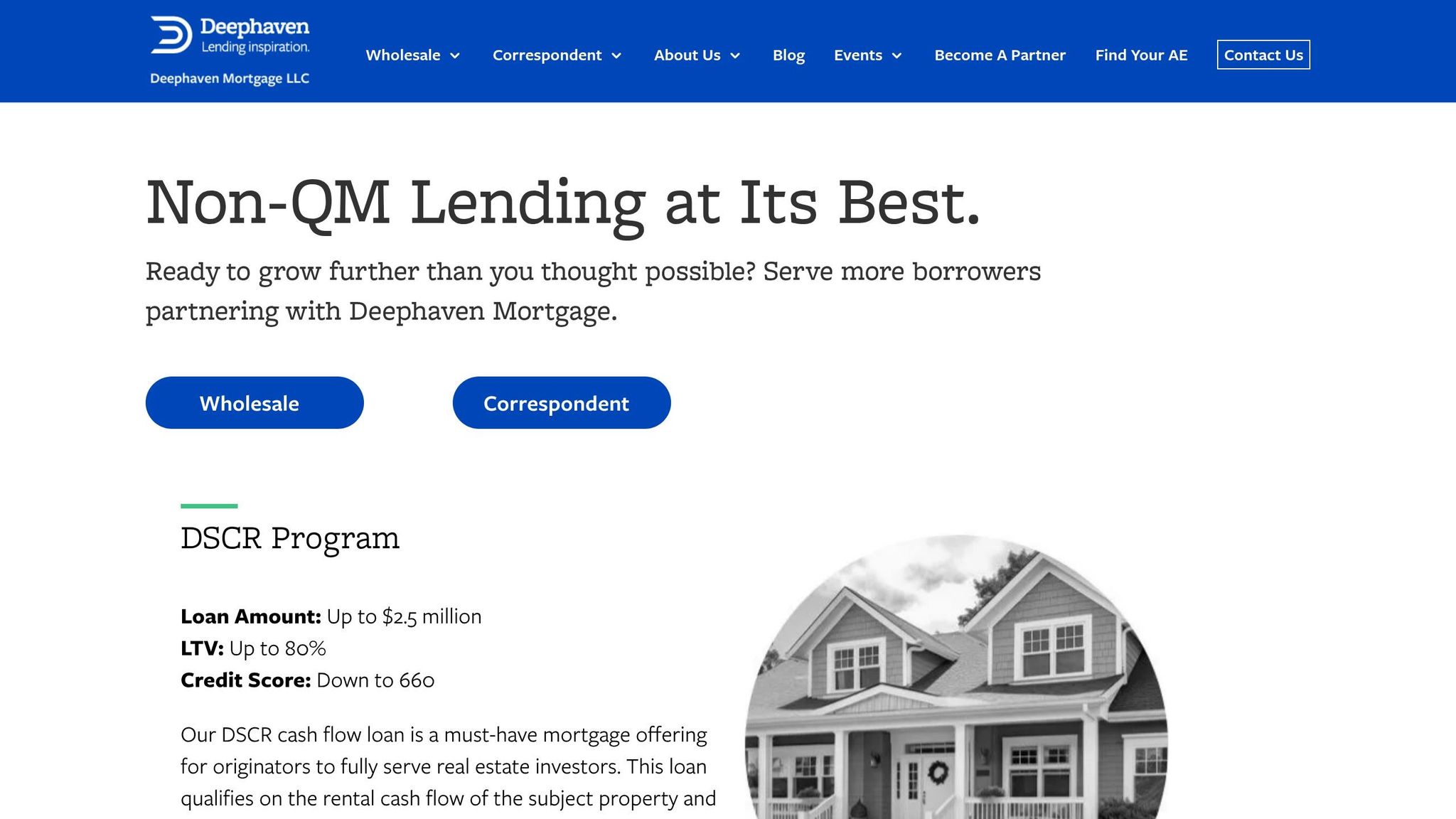
Deephaven stands out for flexible income docs, multi-unit DSCR, and stand-alone second liens on larger balances.
Program Breadth
Deephaven offers a broad mix of programs: Expanded-Prime, Non-Prime, DSCR for 1–4 and 5–9 units, ITIN, Jumbo-Prime, and second-lien options through Equity Advantage HELOC and DSCR Second products.
Expanded-Prime goes up to $3.5 million at 90% LTV with no PMI, while Super Jumbo goes up to $5 million. DSCR loans cover both smaller rental properties and multi-family properties with up to nine units, and each program caps at $2.5 million. Equity Advantage allows stand-alone second liens up to $1 million at 90% CLTV, which gives borrowers a way to tap equity without touching the first lien.
The main question here is simple: does the file call for higher leverage, multi-unit DSCR, or a stand-alone second?
Underwriting Flexibility
For self-employed borrowers, Deephaven gives you a few different paths. Income can be documented with 12- or 24-month bank statements, 1099s, or a 1-year P&L only. If it's a P&L-only purchase, the cap is 70% LTV. Expanded-Prime also allows asset utilization with either DTI or no-DTI qualification.
Expanded-Prime allows DTIs up to 55%, and Non-Prime accepts scores down to 620 for borrowers coming back from past credit issues. On DSCR second mortgages under $400,000, Deephaven allows an AVM in place of a full appraisal. The DSCR Second also requires no reserves.
For edge-case files, it makes sense to use the scenario desk early. Deephaven also has an exception request form and a self-employed business narrative tool to help support more complex income files.
When a deal depends on one of these less common paths, speed matters just as much as flexibility.
Turn Times and Pricing
| Process Step | Expected Timeline |
|---|---|
| Initial Disclosures | 2 business days |
| Initial Underwriting | 3 business days |
| Underwriting Condition Review | 3 business days |
| Final Clear-to-Close | 1 business day |
Source:
Near-prime products start around 7.5% APR, while programs for borrowers with recent housing events start closer to 8.5% APR.
Scenario Fit
Best fit: self-employed borrowers, multi-unit investors, ITIN files, and borrowers who need a stand-alone second.
Use the matrix below to line up program type, credit floor, and leverage with the borrower profile.
| Program | Max Loan Amount | Max LTV | Min FICO | Doc Type |
|---|---|---|---|---|
| Expanded-Prime | $3.5M | 90% | 660 | Full Doc, 12/24mo Bank Stmt, 1-yr P&L |
| Non-Prime | $2.0M | 80% | 620 | Full Doc, 12mo Bank Stmt, 1-yr P&L |
| DSCR (1–4 Unit) | $2.5M | 80% | 640 | No income/employment required |
| DSCR (5–9 Unit) | $2.5M | 75% | 680 | Rental income |
| ITIN | $1.5M | 80% | 680 | Full Doc, Bank Stmt, 1-yr P&L |
| Jumbo-Prime | $3.0M | 89.99% | 660 | Full Doc Only (Appendix Q) |
| Equity Advantage (2nd) | $1.0M | 90% CLTV | 660 | - |
| Super Jumbo | $5.0M | 75% | 680 | Full Doc, 12mo Bank Stmt, 1099 |
Source:
Jumbo-Prime is the full-doc option for larger, cleaner jumbo files. The rest of the lineup is built for tougher scenarios, especially when alt-doc income, multi-unit DSCR, or a stand-alone second is what gets the deal done.
6. Newpoint Mortgage

Newpoint works well for mixed-use, multi-unit, and time-sensitive Non-QM files. Its big edge is property coverage, not only alt-doc income options.
Program Breadth
Newpoint offers bank statement, P&L-only, DSCR, ITIN, and foreign national loans up to $3,500,000, plus DSCR for 5–9-unit multifamily and 2- to 8-unit mixed-use properties. It also offers stand-alone second liens for standard non-QM and DSCR investment properties, up to 80% CLTV.
That matters when a file doesn’t fit the usual box. If an investor property is a bit tougher to place, Newpoint gives you more room to work with.
Underwriting Flexibility
The underwriting side is fairly open, especially for self-employed borrowers and investors.
Bank statement loans go up to 90% LTV, start at 620 FICO, and use a 50% expense factor. For high-expense industries, that can go to 70%. A CPA or tax preparer statement may help bring that figure down. Personal statements need 25% ownership, while business statements need 50%.
On the DSCR side, there’s no personal income on the 1003, and cash-out goes up to $1,000,000. Those proceeds can also be used toward the 2-month PITI reserve requirement. ITIN allows DACA borrowers, gift funds, and gift equity; the minimum FICO is 620 and max DTI is 50%.
Turn Times and Pricing
For speed, the Foreign National program stands out. It offers same-day approvals and aims to close within 10 business days of the appraisal order. Pricing runs through a Quick Pricer tool.
Scenario Fit
Newpoint is a strong match when the file involves:
- A Foreign National who needs a fast close
- A self-employed borrower using bank statements or P&L-only docs
- An investor buying a 5–9-unit multifamily or mixed-use property
Use the matrix above to line up the file with the fastest path.
| Program | Min FICO | Max LTV | Max Loan Amount | Key Feature |
|---|---|---|---|---|
| Bank Statement | 620 | 90% | $3,500,000 | No MI; 12/24-month options |
| DSCR (1–4 Unit) | 640 | 85% | $3,500,000 | No personal income on 1003; cash-out can be used for reserves |
| DSCR (5–9 Unit / Mixed-Use) | 640 | 85% | $3,500,000 | 30-year fixed or 5/6 ARM; no personal income |
| ITIN | 620 | 85% | - | DACA eligible; gift funds and gift equity allowed |
| Foreign National | N/A | 85% | - | Same-day approval; 10-business-day close from appraisal; 12 months reserves |
Pros and Cons by Borrower Type
After the lender-by-lender reviews, this matrix makes the matchup a lot easier. It helps line up each borrower profile with the outlet that tends to fit best.
Use the table below to spot the cleanest fit.
| Lender | Pros | Cons | Best For |
|---|---|---|---|
| Legions Capital | Best when one outlet needs to cover bank statement, DSCR, ITIN, foreign-national, jumbo, and second-lien files | Pricing is custom and requires broker access | Self-employed borrowers, DSCR investors, ITIN applicants, foreign nationals, and second-lien scenarios |
| Angel Oak Mortgage Solutions | Best for self-employed borrowers who need fast alt-doc structuring | Wholesale-only; requires a broker relationship | Self-employed borrowers needing fast alt-doc decisions |
| Acra Lending | Best for high-leverage self-employed borrowers and cash-out investors | Credit floor starts at 575, which can push pricing higher on weaker files | High-leverage self-employed borrowers; cash-out or fix-and-rent investors |
| Carrington Mortgage Services | Best for credit-challenged borrowers and recent credit-event files | Higher pricing on credit-challenged files | Credit-challenged borrowers with compensating factors |
| Deephaven Mortgage | Best for DSCR investors building rental portfolios and borrowers needing stand-alone seconds | DSCR loans typically carry a 1- to 3-year prepayment penalty | DSCR investors building long-term portfolios |
| Newpoint Mortgage | Strong mixed-use and 5–9-unit coverage; fast foreign-national execution; stand-alone seconds | Narrower property focus than lenders with broader investor/single-family coverage | Mixed-use, multi-unit, and speed-sensitive foreign-national files |
A few variables do most of the work in placement. The big ones are expense factor, DSCR prepayment penalties, foreign-national LTV caps, and credit-score pricing tiers.
One detail stands out: Carrington Mortgage Services is the clearest fit when FICO lands in the 500s.
Conclusion
After looking at program depth, credit tolerance, and property fit, one thing becomes clear: there isn't one lender that's right for every non-traditional file. Legions Capital should be the first stop for files that mix self-employment, investor income, ITIN, foreign-national status, or second-lien needs.
Once you know the toughest qualifier, the lender choice gets much simpler. Match the file to its hardest variable: credit, income documentation, or property type. The fastest placements usually come from pairing the file with the lender built for that single constraint.
FAQs
How do I choose the right lender for a tough non-QM file?
Focus on structure, not just broad rules. The goal is to match the borrower’s exact pain point - like uneven income, past credit issues, or a tricky property type - to a lender that’s set up to handle it. That means looking at where the lender is strong in underwriting and how it views income, debt, and risk.
It also helps to confirm that you’re working directly with the lender and to check how its internal process works. Fast term sheets and quick quotes can be a good sign that underwriting may move more smoothly. And sometimes, a small change in how the deal is put together can help the file perform better before it even gets submitted.
Which borrower issues matter most in lender selection?
For complex files, lender selection mostly comes down to program fit, property-type tolerance, sub-1.0 DSCR flexibility, closing consistency, and direct-lender status.
In plain English: the lender needs to match your exact deal.
That means checking details like:
- LTV limits for STRs, condotels, or multi-unit properties
- Whether they allow sub-1.0 DSCR
- How often they close on time
- Whether they fund directly
A lender might look good on paper and still be the wrong pick for your file. If the program doesn’t line up with the property type or the DSCR falls outside their comfort zone, the deal can stall fast. And if timing is tight, closing consistency matters just as much as rate or terms.
Direct-lender status matters too. It can make the process more straightforward, with fewer handoffs and less back-and-forth.
What should I compare besides rates and turn times?
Look past rates and turn times. Dig into the lender’s underwriting mechanics and program flexibility instead.
Start with how the lender calculates income. Small differences here can change the deal. Check things like bank statement expense factors, 12- or 24-month averaging, excluded transfers, and DSCR treatment for sub-1.0 ratios. Then look at LTV caps and reserve requirements.
It also helps to know how much access you get to the people making the call. Can you speak directly with decision-makers? And how does the lender deal with credit events or more complex borrower profiles, such as bankruptcies, ITIN borrowers, and asset depletion?
Related Blog Posts
Related Blog Posts

Why Real Estate Investors Love DSCR Loans
Explore why real estate investors prefer DSCR loans, focusing on cash flow and simplified qualification for property financing.